Today, at 10.45am eastern, I’ll be presenting ”Developing a Progressive Mobile Strategy” to the fine folks at HighEdWeb Rochester. Here is the slidedeck for those who want to follow from home. The hashtag for the conference is #hewebroc. I had hoped to include the script for the talk as notes on the slidedeck but my Keynote presentation was too big for Slideshare so I simply exported it as PDF. I’ll run back this week and update the notes when I have time. The notes have now been added on SlideShare. Hope you find the talk useful. Also, there is now a PDF version that is available.
After I posted an article about foursquare and its use at West Virginia University, Matt Klawitter (@MattKlawitterWU) asked me on Twitter, ”How does this compare to other check-in data — do you use others such as FB?” Well, the only geo-location service that we actively advertise is foursquare but, after that question, I was curious how it matched up against a possible behemoth like Facebook Places and one service that is popular with a co-worker, Gowalla.
The Data
I took the top nine official foursquare venues at WVU and compared them against check-in data totals that I found by browsing the search results in both Facebook and Gowalla. The caveats:
- This is not meant to be completely scientific as I’m doing this quickly on a lark.
- Both Facebook Places and Gowalla have multiple entries for a few locations. I decided just to take the best performing entry and use its numbers for the chart.
- The time periods for collecting the data could be different. For example, Facebook Places hasn’t been around as long as foursquare so foursquare could and probably does have a natural lead. Facebook Places launched in August which is well before we actively advertised foursquare on campus so I don’t think it has that much of an advantage.
- The Health Sciences Center would be a top nine foursquare venue but I left it out because it covers a heck of a lot of locations under one umbrella.
The Results
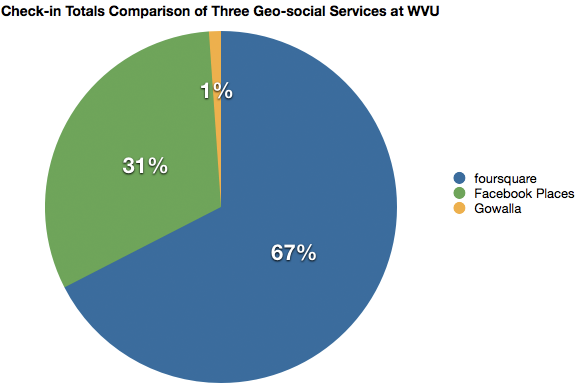
Below are two charts comparing check-ins at select WVU locations between foursquare, Facebook Places and Gowalla.
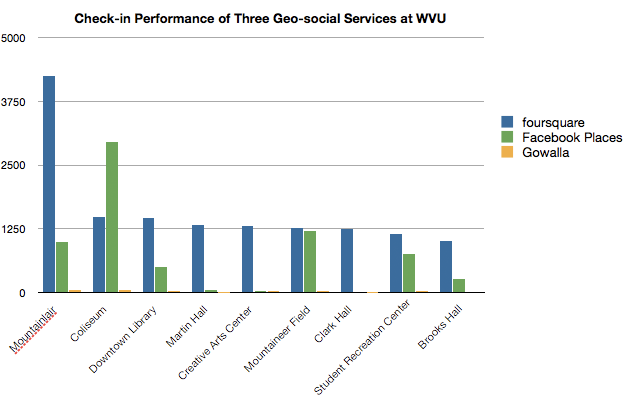
While the charts are useful I figured I’d also share the data just in case.
| Location | foursquare | Facebook Places | Gowalla |
|---|---|---|---|
| Mountainlair | 4,239 | 994 | 42 |
| Coliseum | 1,484 | 2,955 | 56 |
| Downtown Library | 1,457 | 501 | 21 |
| Martin Hall | 1,324 | 42 | 7 |
| Creative Arts Center | 1,303 | 37 | 36 |
| Mountaineer Field | 1,269 | 1,209 | 39 |
| Clark Hall | 1,255 | 8 | |
| Student Recreation Center | 1,149 | 759 | 28 |
| Brooks Hall | 1,011 | 260 | |
| Total | 14,491 | 6,757 | 237 |
Facebook Places Dominates the Coliseum but foursquare Rules Overall
foursquare, with double the check-ins that Facebook Places has at these venues, obviously takes the top geo-social network on campus. Gowalla is basically non-existent on our campus with less than 2% of the check-ins that foursquare has at the top venues.
Probably the most interesting data-points are the athletic venues. They’re the only ones that have Facebook Places either even or beating, rather handily in the case of the Coliseum, foursquare. If I were able to look at the demographic data for Facebook Places I’d be curious to see if the check-ins tend to skew to an older population. But that’s purely a hypothesis even if it might be, on the face of it, a reasonable one. See Tricia’s comment about WVU Athletics using Facebook Places at our athletic venues.
Any other ideas on why our athletic venues might prove so popular on Facebook Places when no where else on campus, at least when comparing against the top foursquare locations, generates that much interest?
And hopefully this short post answered Matt’s question.
I’ve updated my higher ed mobile directory with 97 new websites. Hopefully these continue to be valuable to folks as they review their options for mobile content and mobile solutions. I’ve added the new sites to this post for your convenience. The full list now contains 274 higher ed mobile websites.
- Adrian College
- Agnes Scott College – ASC Mobile
- Alaska Pacific University
- The Art Institutes
- Austin Peay State University
- Belmont University
- Berry College
- Bethel College
- Bloomsburg University of Pennsylvania
- Boston College
- Brigham Young University
- Buena Vista University
- Carson-Newman College
- Carthage College
- Central Connecticut State University
- Champlain College
- City University of New York
- Cleveland State University
- Coleman University
- College of Saint Benedict / Saint John’s University
- Colorado State University
- Columbia College Chicago
- Columbia University
- Culver-Stockton College
- Delaware Valley College
- Denver Seminary
- Eckerd College
- Emmaus Bible College
- Fairleigh Dickinson University
- Florida College
- Fordham University
- Franklin Pierce University
- Full Sail University
- George Fox University
- Harding University
- Howard Payne University
- Kent State University
- Lamar University
- Lawrence University
- Lawrence Technological University
- Liberty University
- Linfield College
- Loyola University New Orleans
- Mesa State College
- Millikin University
- Morehead State University
- National University
- Northern Michigan University
- Northern State University
- Northland College
- Northwestern College
- Oklahoma Baptist University
- Ripon College
- Rollins College
- San Jose State University
- Seattle Pacific University
- South Carolina State University
- Southeastern Louisiana University
- St. Cloud State University
- SUNY Geneseo
- SUNY Institute of Technology
- University of Alaska
- University of California Berkeley
- University of California Los Angeles
- University of California Riverside
- University of Cincinatti
- University of Florida – UF Mobile Web
- University of Louisiana at Monroe
- University of Nevada Las Vegas – UNLV Mobile
- University of North Caroline Asheville
- University of North Texas
- University of St. Thomas
- University of Scranton
- University of Tennessee Chattanooga
- University of Tennessee Martin
- University of Wisconsin Oshkosh
- Utah State University
- Virginia Commonwealth University
- Wayne State University
- West Chester University
- West Virginia University – Tournaments
- Westminster College
- Wichita State University
- Winston-Salem State University
- Woods Hole Oceanographic Institution
- Xavier University
- Xavier University of Louisiana
- York University – Future Students
Editor’s note: The following few mobile websites have been suggested to me since publication. Feel free to let me know of more.
- Brown University
- University of Alberta
- University of Missouri – Engineering
- Volunteer State Community College
With the close of the spring semester it’s time to start looking at numbers from our various products to see where we can improve. One product that I was really interested to review this year was our presence on foursquare. We joined the ”foursquare for Universities” program in late October last year and at that time I wrote up a blog post about how I thought foursquare could be used by universities. We’ve also featured foursquare on our Connect to WVU website as well as our social media footer.
So far we’ve just been experimenting with foursquare. When we started with it our primary goal was simply to make sure the data was correct. As we move towards the upcoming fall semester I expect us to use it more with projects. There are definitely a lot of interesting possibilities with this service.
If you’re interested in learning more about foursquare be sure to check out a good list of foursquare-related resources that Tiffany Broadbent (@tb623) recently put together. John Lucas (@jplucas55) also posted a nice article about @UWMadison‘s experience with foursquare in LINK.
The Source of the Data
Because I have my own tool for tracking foursquare usage I wanted to be clear that the data for these charts comes from foursquare’s own statistics download available in the “Manager’s Tools”-section of our foursquare account page. For us, data started being recorded on Dec. 6, 2010 even though we had been a part of the program for at least a month by that date. Also, in comparison to the numbers I’ve run I believe some data was purged at some point. If you decide to replicate what I’ve done you’ll be in for a bit of a copy & paste slog. Other than the demographic data the venue data isn’t listed in any really useful way for comparison.
Demographics
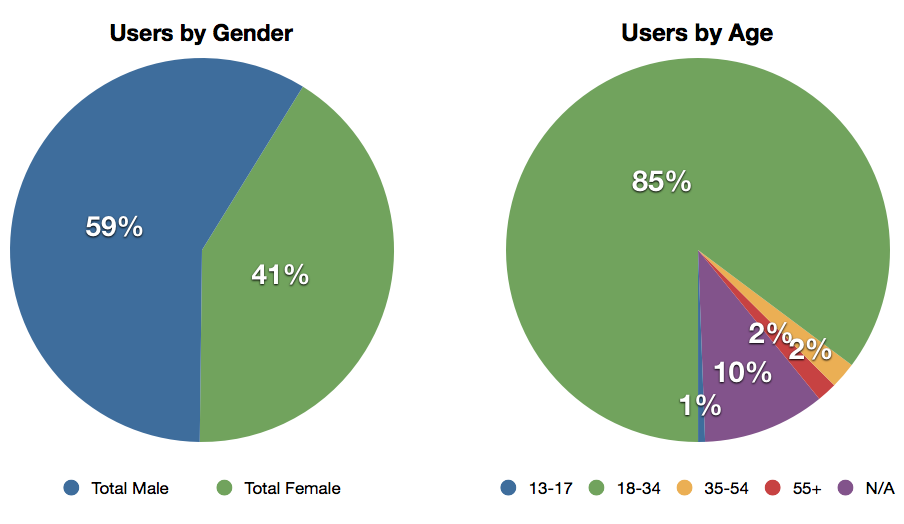
I don’t think these numbers offer anything really surprising. There’s a rough 50/50 split based on gender for those users who have checked in at one of our venues. Considering the population of our campus the 18-34 age group absolutely dominates. I wish we were able to look at more granular age ranges here to narrow down the population more (e.g. freshman pick-up of the service vs. senior pick-up of the service).
Tracking the Check-ins
Between Dec. 6, 2010 and May 24, 2011 the total number of foursquare check-ins grew by 250%. There had been 13,216 check-ins all-time at our official venues by Dec. 6 and we finished out at 33,425 check-ins. Using my unofficial numbers we had added ~3,000 check-ins in the month of November alone. So, on the face of it, a decent rate of growth.

I think when you look at the rate of check-ins though it’s a little more underwhelming of a number. Our max check-in day was April 4, 2011 with 359 check-ins. I have no idea why that day is so popular. The average for the time period is ~150 check-ins per day. The good news is that after spring break we were averaging 190 check-ins a day so there’s definitely a sign of improvement. You can also see that improvement in this chart of check-in rate by day.

On a campus this size though… again, it seems underwhelming. Though I do have to wonder how much dark check-ins have an effect on check-ins at our official venues. Basically, are users more likely to check into an office “venue” that they’ve created as opposed to the building where their office is located?
Finally I tried to organize venues by a very loose type. Essentially I wanted to see if there were specific types of locations that monopolized check-ins at the school. Our student union, the Mountainlair, definitely holds a very large percentage of total check-ins.

By far the most underwhelming type of venue is the dining. I honestly thought that would perform much better. Maybe that’s the kind of venue that would benefit from special deals.
Miscellaneous Data: Photos, Tips, & Badges
While uses of special deals are available in the dump of data from foursquare surprisingly photos & tips are not. To me they’re some of the more interesting ways our users interact with our venues sans special deals.
From my unofficial source there have been 178 tips left on our venues. I wish I had totals on how many have actually been completed. It’s something I’ll have to look at the API for to see if I can tease that kind of information out of it. One of the more interesting things we’ve done with tips is leave them at alumni gathering spots.
One fairly recent addition to foursquare was support for users to add their own photos to venues. So far we’ve had a total of 27 photos added to our venues. This feature is one of the more exciting ones to me. Between the foursquare app and the API I think this could be a really useful way for schools to collect imagery and build integrated web & location-based social experiences. Of the 27 photos 8 were added at basketball games.
Badges… one of the selling points for foursquare and, specifically, the university program is the ability for users to collect special badges. As someone wanting to evaluate use I’d love to know how many users collected school-specific badges and which ones. It might help us figure out use patterns. At the moment it doesn’t appear that their is any way to see this data.
Conclusion
So the final word on this? Really not too bad. Definitely areas for improvement but, most importantly, with the API and a focus on some of our more popular venues their may be some cool possibilities. We definitely achieved our goal this first year of making sure the data was correct. This next year is where we see if we can really leverage the service.
Update: Well, this talk has come and go. Check out the slidedeck…
I’ll be giving a talk, entitled Developing a Progressive Mobile Strategy, at HighEdWeb Rochester on June 27. It’s essentially going to be a reboot of an old blog post of mine based on what we’ve learned about mobile at West Virginia University over the last two years. The conference has a nice set of talks with several touching on mobile. It appears that space is filling up fast for the conference so make sure to register. Hey, it’s $30 and you’ll get to meet a bunch of great folks. Frankly, I’m looking forward to talking to & sharing with other higher ed folks as much as attending the talks. Hopefully, I’ll get to meet a few readers there too. Drop me a line if you’re going!