I will be attending the Design for Mobile conference in Chicago between October 20-24, 2010. The conference bills itself as:

Design for Mobile is the first and only North American mobile user experience conference. The focus is on strategy and tactics for user research, product definition, interaction and other design, and usability testing.

While I thought the conference schedule looked great and saw that there were a lot of great speakers presenting at it the thing that really tipped the scales for me was the price. It’s only $500 for academic professionals. That price does mean we miss out on preliminary and advanced workshops but I think it’ll still be well worth it. Regular price for those three days looks like it’d be $1,800 or so. So definitely a generous deal.

I think the thing I’m most looking forward to learning more about at the conference is user-centered design in the mobile space. I get so caught up in implementing the technical details that I sometimes lose sight of what’s really wanted or what will actually work best for the user. Hopefully that knowledge can be transferred to Mobile Web OSP so that other institutions can also benefit.

For folks on Twitter the conference hashtag is #d4m2010 and here are the Twitter handles for some of the speakers (the ones I’m following at least):

If you’re going to the conference drop a line in the comments. Maybe we can get a higher ed meet-up together to share notes and best practices.
This article was posted

Hot on the heels of v2.0.1 of Mobile Web OSP comes v2.0.2. There are two diffs that cover the code changes (diff #1 & diff #2). The code is obviously in the repo. This release addresses two issues:

  1. The homescreen icons for WebKit devices in the default theme are now properly referenced. They’ll now load correctly when you first bring up the system.
  2. The reference to the Google Analytics tracking pixel in the basic template has been updated. This was causing a doubling of hits in the PageViews table for devices using those templates. It shouldn’t have skewed stats too much but definitely put this fix into your own code if you can.

If you’ve found an issue or bug please let me know so that I can fix it for others.

This article was posted

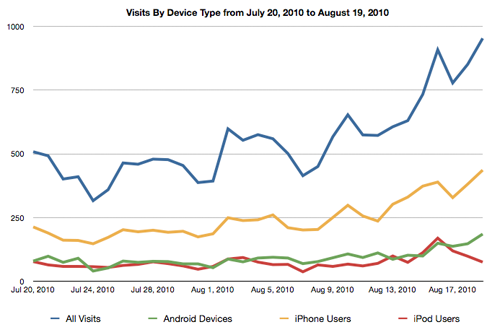
As we head into the new semester (freshman arrive today!) I wanted to see how device usage played out over the summer on WVU Mobile Web. With all the talk of Android, and watching a student buy a Samsung Galaxy S at the AT&T store, I figured it’d be a good time to review the numbers. So with that in mind let’s look at some for the last month. Note: The caveat to this data is that iPod usage is really driven by on-campus students and we obviously haven’t a whole lot of them recently.

We’ll start with pretty charts:

Visits by Device to Mobile Web from July 20 to August 19 2010

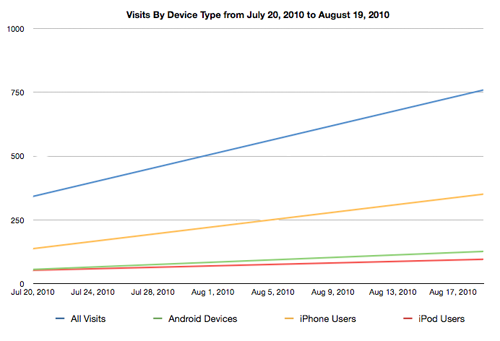
But maybe a trend line will be a little easier to see:

Trendline of Visits by Device from July 20 to August 19 2010

I’m hopeful that the trend for Android holds out. While I do own an iPhone I believe it’s important that other devices get on the scene to bring the mobile web to other users and force companies to start thinking about it instead of native apps. The overall traffic trend has me surprised in that it has picked up so quickly and even before a lot of students have arrived back on campus. I hope this bodes well for good numbers this year. Getting back to the cage match…

In terms of usage the iPhone accounted for 44% of visits during this time. Android accounted for 16.5% and iPod only 13%. During the last school year iPhone and iPod usage were even so we’ll see how that holds out to start the new school year and how that affects Android. Beyond really basic usage numbers everything else was surprisingly even between the devices. From pages viewed to bounce rates to percentage of new visits basically all the numbers are relatively even. The only metric with a real difference was time spent on the site. It definitely skewed towards Android with those devices accounting for an average of 7 minutes spent on the site per visit. 5.30 minutes was spent by users with an iPhone and users with an iPod spent a measly three minutes per visit.

I was also curious if type of device mattered in terms of a user exiting out of WVU Mobile Web and using the main home page since these devices promise ”the real web.” 20% of iPhone users (1 in 5, yikes!) bounced to the home page at some point in their use while only 16% of Android and iPod visits bounced to the home page. Over the semester I’m going to keep an eye on this key data point. We force mobile requests for our home page to our mobile site so if the number rises considerably we’re going to have to reevaluate that stance. That number has trended much lower in the past so maybe it’s just a summer thing.

To sum up, in raw usage the iPhone is still the device to beat on WVU Mobile Web but the trend might be picking up for Android. We’ll have a rematch between the devices in the next month to see if students brought Android devices back with them for the new school year.

Curious about any other aspect of our usage patterns? Drop me a line in the comments.

This article was posted

For a while it has seemed like jQuery was missing the boat on a mobile-optimized version of their framework. I went so far as to try to build out my own custom version of jQuery to limit its footprint to only those features I really needed (that didn’t work out too well). I always figured that the jQuery team would just release a smaller, nimbler version of the framework. Boy, was I wrong.

Last week the jQuery team announced the jQuery Mobile framework. The good news? The strategy is for the framework to do all the heavy lifting for the developer in terms of optimizing look & feel for a long-list of A-class devices. The bad news? There’s no actual product yet.

So far jQuery Mobile is basically a manifesto and some pretty design concepts. I’m hopeful that they can really deliver on this product towards the end of 2010 like they’re claiming. Frankly, I’d be happy if they released a product which didn’t support everything but they were able to slowly upgrade behind the scenes if it meant I could get my hands on it faster. I really want to see if the code will work for me.

Currently Mobile Web OSP is using jQTouch for its fun device interactions on iPhone and Android. jQTouch is a nice plug-in for jQuery but it hasn’t seen much movement this year. The original developer for it went off to do mobile development for ExtJS which then ended up releasing Sencha Touch. Unfortunately Sencha Touch is a non-starter as far as Mobile Web OSP is concerned because of how it builds content layouts. The inclusion of jQTouch was enough of a architecture change that I’m not sure the benefits of a second, even bigger architecture change really makes sense.

But even if you’re not using Mobile Web OSP it looks like there’s another mobile JavaScript framework on the way to help you deliver your Web 2.0 inspired mobile web app.

This article was posted